| Issue |
Sci. Tech. Energ. Transition
Volume 81, 2026
Enabling Technologies for the Integration of Electrical Systems in Sustainable Energy Conversion
|
|
|---|---|---|
| Article Number | 7 | |
| Number of page(s) | 21 | |
| DOI | https://doi.org/10.2516/stet/2026009 | |
| Published online | 6 avril 2026 | |
Regular Article
Bio-inspired Novel Liver Cancer algorithm for solving large-scale combined heat and power economic dispatch problems
Department of Electrical and Electronics Engineering, School of Engineering, Anurag University, Hyderabad 500088, Telangana, India
* Corresponding authors: Cette adresse e-mail est protégée contre les robots spammeurs. Vous devez activer le JavaScript pour la visualiser.
; Cette adresse e-mail est protégée contre les robots spammeurs. Vous devez activer le JavaScript pour la visualiser.
Received:
6
May
2024
Accepted:
3
February
2026
Abstract
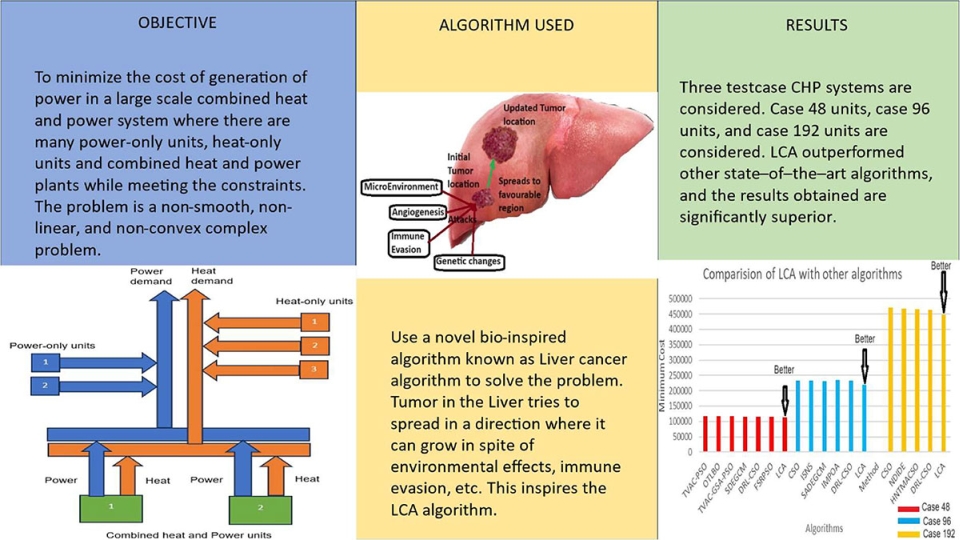
The potential of Combined Heat and Power (CHP) systems to enhance the economics and sustainability of the electricity system is garnering increasingly attention. The fact that these systems can have numerous generation units whose functions are controlled by intricate non-linear physics makes it challenging to determine how to operate them optimally. The complex interconnections within bulk power systems pose significant challenges in solving economic dispatch problems, particularly in large-scale Combined Heat and Power Economic Dispatch (CHPED) scenarios, which are difficult to address due to intricate thermal and electrical connections in cogeneration units. The current research work proposed a bio-inspired novel Liver Cancer Algorithm (LCA) to optimize a large-scale CHP economic dispatch system. The LCA algorithm employs genetic operators and a Random Opposition-Based Learning (ROBL) technique to effectively achieve a balance between local and global searches and thoroughly explore the search space. The mutation rate is adjusted based on the number of iterations, and the higher mutation rate facilitates the exploration of promising new locations and protects the algorithm from being trapped at a local minimum. Hence, a better optimum value can be achieved in less time. To investigate performance, the proposed method has been demonstrated on CHPED problems involving one medium and two different large-scale test systems, 48, 96, and 192 units, respectively, and the results were compared to other state-of-the-art powerful approaches. The experimental results indicated that the LCA algorithm surpasses other methods in solving medium and large-scale CHPED problems.
Key words: Cogeneration / Combined heat and power (CHP) / CHP economic dispatch (CHPED) / Liver cancer algorithm (LCA) / Levy’s flight function / Random opposition-based learning (ROBL) / Genetic operators
© The Author(s), published by EDP Sciences, 2026
 This is an Open Access article distributed under the terms of the Creative Commons Attribution License (https://creativecommons.org/licenses/by/4.0), which permits unrestricted use, distribution, and reproduction in any medium, provided the original work is properly cited.
Current usage metrics show cumulative count of Article Views (full-text article views including HTML views, PDF and ePub downloads, according to the available data) and Abstracts Views on Vision4Press platform.
Data correspond to usage on the plateform after 2015. The current usage metrics is available 48-96 hours after online publication and is updated daily on week days.
Initial download of the metrics may take a while.